

By Mahmud Tim Kargbo
Public debates surrounding major investment decisions require more than strong opinions; they require facts, context and a careful understanding of economic principles. The ongoing discussion surrounding Aminata and Sons Sierra Leone Limited’s proposed petroleum storage expansion has attracted national attention because it touches on taxation, government revenue, private sector participation and Sierra Leone’s long term energy security. Several publications, including Sierraloaded, SwitSalone and OWLPRESS, have raised concerns about the proposed arrangement between the Government of Sierra Leone and Aminata and Sons Sierra Leone Limited. Reference: http://www.sierraloaded.sl, http://www.switsalone.com, http://www.owlpress.sl. Their concerns about transparency, accountability and value for money are legitimate issues in any democratic society. However, a complete economic discussion must also examine what is being built, the infrastructure gap being addressed and the wider national benefits associated with increased petroleum storage capacity.
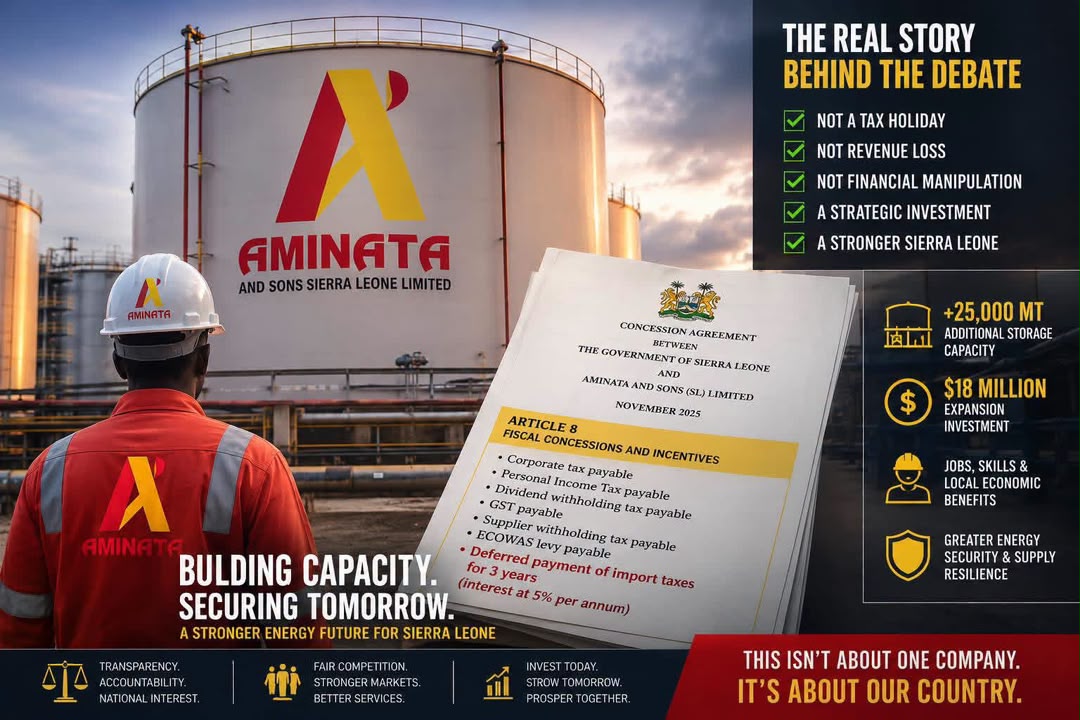
The debate has often been framed around whether Aminata is receiving an unfair advantage through fiscal support. However, this framing requires closer examination because the November 2025 Concession Agreement does not present a situation where the company has been removed from Sierra Leone’s tax system. Article 8 of the agreement outlines a structured arrangement where the company continues to have tax obligations while receiving targeted support connected to petroleum storage infrastructure development. The distinction between a tax exemption and a deferred payment arrangement is central to understanding the issue. A tax exemption removes or reduces an obligation. A deferred payment arrangement does not remove the obligation; it changes the timing of payment under agreed conditions. This difference is not a technical detail; it is the foundation of an accurate public discussion.
The SwitSalone publication titled “Sierra Leone blocks Aminata fuel deal saving $33 Million in taxes” presented concerns that the proposed arrangement could result in approximately $11 million annually and a total of $33 million over three years in potential government revenue impact. Reference: http://www.switsalone.com. However, the language used represents a projected fiscal impact based on an interpretation of the arrangement, not an established loss already incurred by the Government of Sierra Leone. A projected reduction in immediate revenue collection is not the same as permanent revenue loss. Fiscal analysis must consider both the timing of government receipts and the economic activity generated by productive investment. A company that remains operational, expands infrastructure, employs people and contributes to future economic activity can create value beyond the immediate tax period. The relevant policy question is therefore not only what revenue arrives today, but what economic capacity is created for tomorrow.
A deferred payment arrangement is a recognised economic mechanism used by governments, businesses and financial institutions around the world. It is often considered when a project requires substantial upfront investment and temporary cash flow flexibility. In the case of Aminata, the company’s argument is linked to the challenges experienced during the development period. The company secured approximately a $20 million commercial bank facility based on projections that operations would commence in 2023. However, global disruptions, including COVID 19 related supply chain challenges affecting construction materials from international markets, delayed completion until early 2024. The International Monetary Fund documented the significant economic disruption caused by the pandemic, particularly for businesses affected by global supply chain interruptions. Reference: http://www.imf.org/en/Topics/imf-and-covid19. The company began operations while facing accumulated financial obligations created by delays outside the original projections.
The argument that Aminata is seeking a tax holiday also requires correction. Article 8 of the agreement shows that the company remains responsible for several statutory obligations. The agreement provides that Aminata shall continue paying corporate tax consistent with applicable laws. It also maintains obligations relating to Personal Income Tax, dividend withholding tax, Goods and Services Tax, supplier withholding taxes and the ECOWAS levy. These provisions demonstrate that the company is not being removed from the national tax framework. The incentives provided are mainly connected to investment infrastructure, including machinery, equipment, plants and facilities required for petroleum storage expansion. The difference between supporting infrastructure development and removing tax responsibility must remain clear.
Article 8.8 and Article 8.9 specifically connect the incentives to the construction, rehabilitation and operation of petroleum storage facilities. These provisions relate to plants, equipment, machinery, turbines, pumps and other assets required to develop storage capacity. Such incentives are different from supporting ordinary commercial activity because they are tied to the creation of physical infrastructure. Aminata’s proposed expansion involves an additional 25,000 metric tonnes of storage capacity, increasing its total capacity from 20,000 metric tonnes to 45,000 metric tonnes. The company has also invested approximately $3.5 million in acquiring two acres of land for future expansion, with the wider expansion programme expected to require approximately $18 million. The economic significance lies not only in the company’s growth but in the additional national capacity created.
The suggestion that deferred payment arrangements automatically create financial manipulation also requires a more evidence based assessment. The existence of a deferred tax structure does not by itself prove misuse. Governments may approve deferred payment arrangements for legitimate reasons, including protecting business continuity, supporting strategic investment, preserving employment and ensuring that productive companies remain financially stable. In Aminata’s case, the argument is that working capital is essential for fuel importation, shipping, storage operations and distribution. A petroleum company requires significant liquidity to maintain supply chains. Weakening that operational capacity could have consequences beyond the company itself because fuel availability affects transportation, businesses and the wider economy.
The argument raised about comparing the 5% interest on deferred tax payments with higher financial market rates also requires careful analysis. Such a comparison assumes that deferred tax obligations function like unrestricted cash available for investment purposes. That assumption requires evidence. A deferred payment arrangement exists within a specific commercial and regulatory framework. The purpose is not to create a financial investment opportunity but to support the continuity of an economic activity while preserving government claims. Any assessment of possible misuse must examine contractual controls, reporting obligations and enforcement mechanisms rather than relying solely on hypothetical scenarios.
The claim that Sierra Leone’s petroleum industry is already a mature and profitable sector also requires a broader understanding. A mature industry does not mean an industry that no longer requires investment. In fact, mature industries often require stronger infrastructure because demand increases and national expectations become higher. Aviation is a mature industry, yet countries continue investing in airports. Telecommunications is a mature industry, yet countries continue expanding networks. Energy systems require continuous improvement because infrastructure determines reliability. A profitable petroleum sector still requires storage, logistics and operational capacity.
The argument that increased storage capacity could create artificial scarcity also requires closer examination. Additional storage capacity generally reduces vulnerability because it provides greater flexibility in managing supply. Scarcity occurs when supply is insufficient, disrupted or deliberately restricted. Storage allows countries and operators to respond more effectively to international disruptions, shipping delays and unexpected market changes. Stronger storage capacity creates a buffer rather than a shortage. A country seeking energy security must therefore view storage infrastructure as a strategic national asset.
The concern raised by OWLPRESS regarding fairness and competition also deserves attention. Reference: http://www.owlpress.sl. Existing petroleum operators have made significant contributions to Sierra Leone’s energy sector and their investments should be acknowledged. However, economic development cannot depend on maintaining infrastructure limitations that prevent wider participation. Competition becomes stronger when businesses compete through efficiency, service delivery and innovation. Additional storage capacity can allow more operators to participate effectively and create a more dynamic market environment.
Economist Michael Porter’s work on competitive advantage highlights that productive competition strengthens markets by encouraging businesses to improve performance and create value. Reference: http://www.isc.hbs.edu. Similarly, development economists have argued that investment in productive infrastructure is essential for countries seeking long term economic transformation. Joseph Stiglitz has written extensively about the importance of creating conditions that support productive investment while maintaining accountability and institutional responsibility. Reference: http://www.josephstiglitz.com. The challenge for Sierra Leone is therefore finding the correct balance between protecting public revenue and encouraging investments that expand national capacity.
Parliament’s responsibility to scrutinise agreements involving public resources must be respected. Democratic oversight is essential, especially where taxation and national assets are involved. However, scrutiny should examine the complete economic picture rather than only the immediate fiscal effect. It should consider the infrastructure created, employment opportunities generated, supply security strengthened and future economic activity supported. Transparency and investment are not competing objectives; they should work together.
The Aminata expansion debate is therefore larger than one company or one agreement. It represents a wider question about Sierra Leone’s approach to economic development. A country cannot strengthen energy security without expanding infrastructure. It cannot encourage competition without creating capacity for participation. It cannot attract investment without considering mechanisms that allow strategic projects to survive challenges and deliver long term value.
The real question facing Sierra Leone is whether the country wants an economy where limited infrastructure determines market participation, or one where expanded capacity creates opportunities for stronger competition and national resilience. The future of energy security depends on building systems that support growth while maintaining accountability. Aminata’s proposed expansion should therefore be judged not only by what is deferred, but also by what is being created.