
By Lemuella Tarawallie
The United Nations Children’s Fund (UNICEF) Sierra Leone on Tuesday (10 March 2026) joined the Government of Sierra Leone (GoSL) and development partners to review the implementation of the UNICEF Country Programme for Children covering the period 2025 to 2030, with a renewed focus on strengthening systems, improving financing for children and expanding services countrywide.
The review meeting brought together officials from the Ministry of Planning and Economic Development, the Ministry of Social Welfare, the Ministry of Basic and Senior Secondary Education, development partners and youth representatives to assess progress made in 2025 and to outline priorities for the coming years.
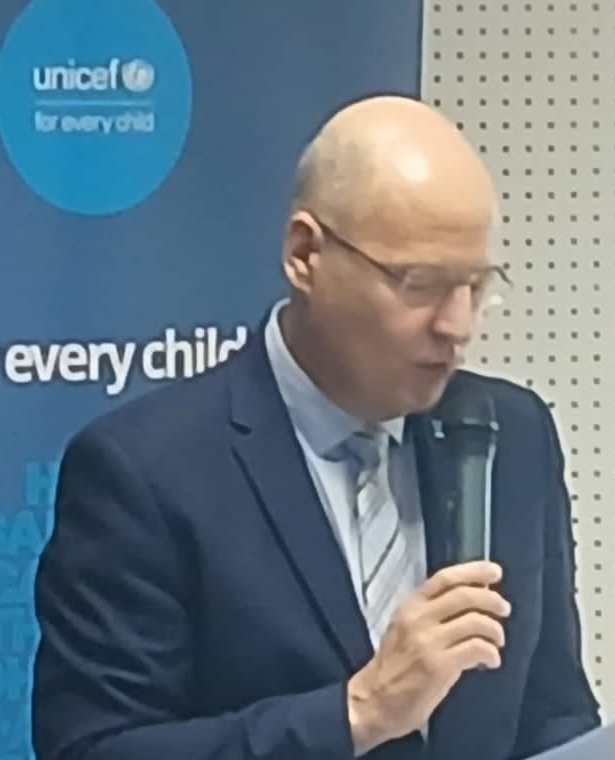
During the review engagement on Tuesday this week at the Mayor’s Hall of the Freetown City Council in Freetown the UNICEF Country Representative, Rudolf Schwenk, expressed appreciation for the continued partnership between UNICEF and the Government of Sierra Leone.
“Let me begin by expressing UNICEF’s sincere appreciation for the strong and constructive partnership we continue to enjoy with the Government of Sierra Leone,” he said. “This annual review provides an important opportunity to reflect on progress for children under our 2025 to 2030 Country Programme of Cooperation and to reaffirm our shared commitment to advancing the wellbeing of every child across the nation.”
Schwenk noted that Sierra Leone recorded several important achievements for children in 2025, including the passage of a new Child Rights Act, the first major update since 2007, which strengthens protection and service delivery for children across the country.
He also highlighted progress made in strengthening national data systems through the launch of the Multiple Indicator Cluster Survey and a digital dashboard designed to track national development priorities.
According to him, significant improvements were also recorded in child survival, education quality and protection services, with expanded access to vaccines, stronger learning systems and survivor-centred child protection services reaching thousands of children.
Schwenk further noted that progress had also been made in climate resilient water sanitation and hygiene services, social protection, disability inclusion and innovation, positioning Sierra Leone as a leader in systems based and equity focused approaches to improving the lives of children.
However, he warned that the global development landscape was becoming more challenging as “international development assistance becomes increasingly constrained”.
“Around the world, official development assistance is becoming more constrained and competition for resources is increasing,” he said. “Despite these challenges, we remain committed to ensuring that every child in Sierra Leone has access to essential services and the opportunity to learn, grow and thrive.”
Delivering her opening remarks the Minister of Planning and Economic Development, Kenyeh Barlay, emphasized the importance of stronger accountability and greater domestic investment in programmes that support children.
She said, “the government is working to ensure system-wide accountability by strengthening collaboration across ministries, departments and agencies to deliver child-centred services”.
Minister Barlay also stressed the importance of innovation and reliable data for development planning, noting that ongoing national surveys including the Demographic and Health Survey would provide critical information to guide policy decisions.
She explained that “the government has also introduced a national tracker system that will allow authorities to monitor progress on development priorities, including child related interventions, on a quarterly basis”.
Deputy Minister of Basic and Senior Secondary Education, Kadiatu Gogra, representing the minister, commended UNICEF for its continued support to the education sector.
She said the partnership had played a significant role in strengthening foundational learning through literacy and numeracy programmes, expanding early childhood development and improving the quality of teaching and learning across the country.
Ms Gogra also highlighted efforts to ensure that vulnerable children, particularly girls and children with disabilities, had better access to education and improved learning outcomes.
She acknowledged that challenges remained, especially in supporting children with disabilities and ensuring smoother transitions from primary to secondary education, and called for stronger collaboration between families, communities and institutions.
During the meeting, UNICEF Communications Advocacy and Partnerships Specialist, Suzanne Wooster, presented key results for children in 2025, noting that community health and nutrition services reached 1.3 million children under five.
She revealed that “under five mortality declined from 104 to 84 per 1,000 live births, while national vaccine coverage surpassed 95 percent and Penta three coverage increased to 93 percent”.
Chief Planning and Monitoring Officer at UNICEF, Robert Ndamobisis, outlined key priorities for the 2026 annual work plan under the theme “Survive and Thrive”. These priorities include reaching zero dose children for vaccination, scaling up integrated community case management for malaria, pneumonia and diarrhea, strengthening maternal and child health interventions and improving the prevention and treatment of child wasting.
The review concluded with a panel discussion involving youth representatives, members of Parliament and development partners.
During the discussion, Phillipa Cride-Dole, President of the National Children’s Forum Network called on Parliament to enact legislation that would protect girls from participating in Female Genital Mutilation until the age of 18, which is the legal age of consent.
Responding to the concern, Chair of the Legislative Committee in Parliament, Hon. Abdulai Sulaiman Marray Conteh, said “as a nation there is a need for broader national dialogue with all stakeholders involved in addressing FGM before taking legislative action.