

By Lemuella Tarawallie
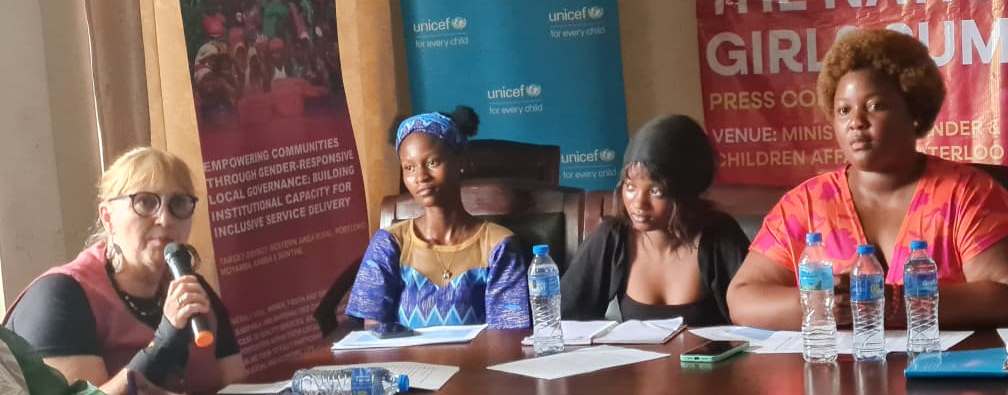
UNICEF, in collaboration with the Girls Advocacy Development Network (GADNet), the Ministry of Gender and Children’s Affairs and other development partners, has officially launched the seventh National Girls Summit with a strong call for girls and young women to speak up, participate in decision making, and take an active role in shaping Sierra Leone’s future.
The official launch was held on Friday 18 September 2026 at the Ministry of Gender and Children’s Affairs Directorate office on Waterloo Street in Freetown.
The Summit, which will take place on 13-17 October in Kenema District, will be held under the theme, “Our Power in Action, Protecting Our Future.” It will also provide a platform for young people to discuss issues affecting their lives and contribute ideas towards national development.
The initiative, organised by GADNet in partnership with UNICEF, the Ministry of Gender and Children’s Affairs and other development partners, is expected to bring together girls and young women across Sierra Leone.
Participants are expected to engage in discussions and activities covering education, health, environmental issues, leadership and mental wellbeing, Artificial Intelligence and issues affecting girls and young women in Sierra Leone.
GADNet Executive Director, Hannah Kargbo, said the National Girls Summit had evolved into an important platform where girls and young people could learn, speak, lead and develop solutions to challenges affecting their lives.
She said the Summit was designed to move beyond discussions by creating opportunities for young people to contribute to national conversations and turn their ideas into action.
UNICEF Country Representative, Mariko Kagoshima, said the growing participation of young people demonstrated the importance of creating spaces where their voices could influence decisions affecting them.
She stressed that meaningful participation should continue beyond the Summit, with stakeholders listening to young people and creating opportunities for them to contribute to national development.
She reaffirmed UNICEF’s commitment towards the Summit and towards supporting girls in Sierra Leone
Assistant Director at the Ministry of Gender and Children’s Affairs, Laura Koroma, described the Summit as “a call to action”, stressing that girls should not be treated merely as beneficiaries of development but as partners in development.
“Your voice is valuable. Your education is valuable. Your dreams are valuable,” she told participants, urging girls to know their rights, recognise their value and speak confidently about their experiences, aspirations and concerns.
She highlighted national efforts to strengthen legal and policy protection for women and girls, including measures addressing gender equality and child marriage.
GADNet HeForShe Ambassador, David A. Sandy, stressed the importance of involving boys and young men in efforts to address gender-based violence, female genital mutilation and other challenges affecting girls.
He said boys and young men should not only be viewed as part of the problem but should also be given opportunities to become part of the solution.
Speaking on the issues affecting girls and young people, Princess Navo Panda of the Girls Advocacy Development Network called for a shift from discussing challenges to taking concrete action. She said girls and young people face challenges in schools, communities, homes and online, stressing that conversations around these issues must translate into meaningful interventions.
Panda called for greater investment in girls’ leadership, education, protection and health, while urging stakeholders to involve young people in developing, implementing and evaluating decisions and programmes that affect their lives.
“We do not only want to be beneficiaries. We need to be involved in developing, implementing and evaluating decisions and programmes that affect our lives,” she said.
Iceland’s Ambassador to Sierra Leone, Ásdís Bjarnadóttir while officially launching the 7th National Girls Summit, she stated that “gender equality remains an important area of Iceland’s foreign policy and development cooperation”.
She said partnerships were essential because “no single institution can address the challenges facing girls and young women alone”.